
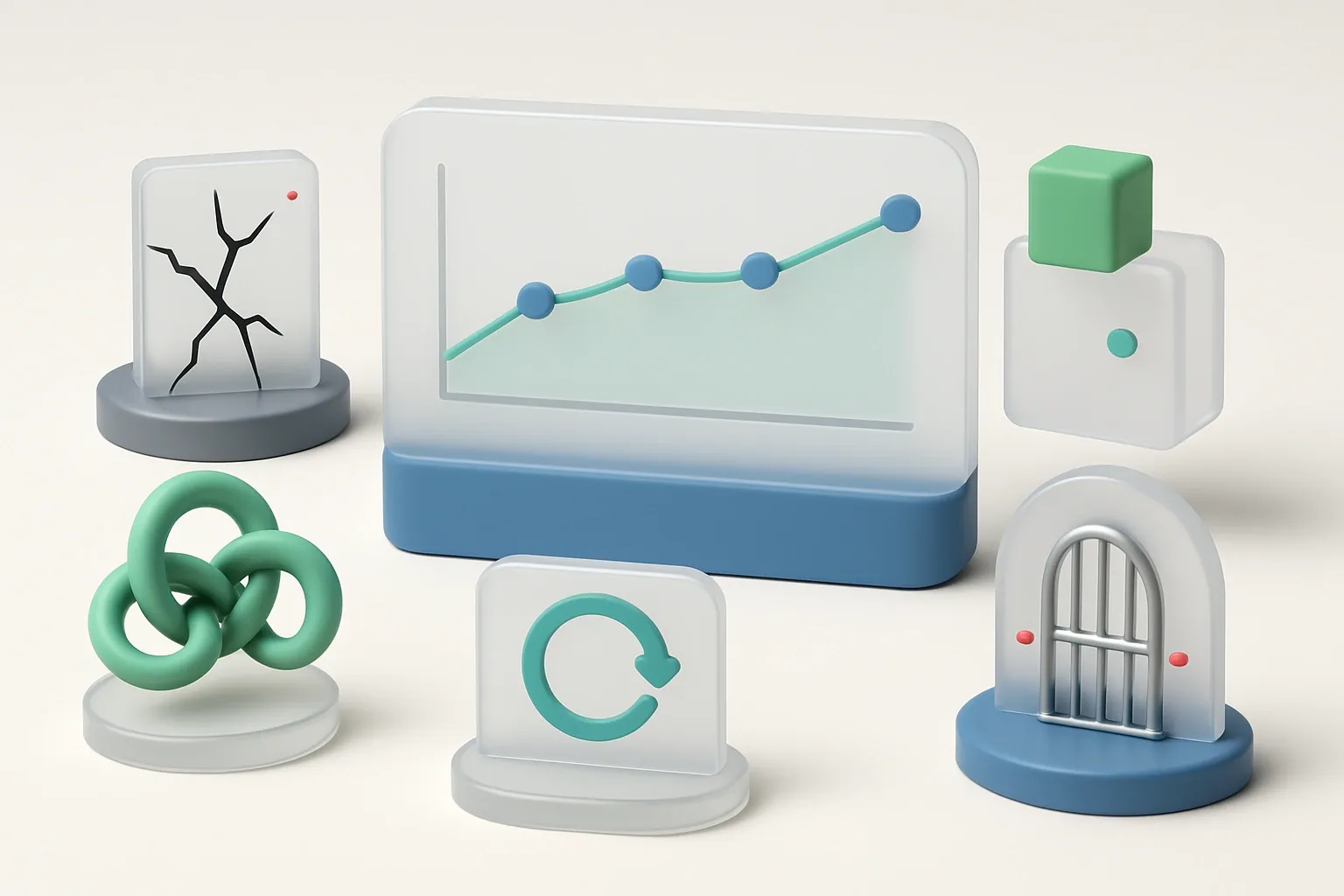

Is Your Software Product Slowing Down? 5 Execution Gaps That Stall Growth.
First of all, don’t panic. Successful software development is never a straightforward journey. It’s only natural to experience bumps in the road.
Every founder we’ve worked with has experienced this problem. And it’s rarely the concept that’s at fault. On many occasions, it’s because of those annoying execution gaps you didn’t see coming. Let’s take a look at five of the most common.
What Is an Execution Gap, Anyway?

In many ways, creating a software development strategy is the easy part. Implementing it is another matter. The difference between your strategy and how you implement is known as the execution gap.
What you planned - what you did = the execution gap.
1. Your Software Development Project Is Accumulating Technical Debt

In your haste to create an MVP or be the first to market, you took a few liberties. Maybe you opted for coding shortcuts. Perhaps you skipped factoring, cut costs with monolithic architecture , or settled for “good enough’ instead of insisting on the highest possible standards.
You now have to deal with a costly and time-consuming execution gap. Because of all your compromises and shortcuts, every new feature requires a lengthy and very painful process. And the results are never as good as they would have been if you’d paid off technical debt as and when it was accrued.
The Fix: Move to an outcome-focused approach to software development . Allocate around 20% of each milestone to reducing your technical debt. Remember: the debt on interest compounds quickly!
2. Feature Creep Is Making Your Software Product a Mess

Throw enough sh** at the wall, and some of it might stick, right? Wrong. Straying too far from your original scope and running before you can walk has the potential to derail your product before it starts delivering returns.
We call it the “just one more thing” approach to application development. Before you know it, your UX is a cluttered mess. Maintenance costs are spiraling. The pinpoint focus you started with is now obliterated. And rather than nailing the core functionality of your digital product, you’re now firefighting across several unnecessary features.
The Fix: Choose and stick to a single priority during each sprint or milestone. Get comfortable with saying no to stakeholders, and focus on what adds value — and nothing else.
3. Scaling Your Workforce without Scaling Your Systems Spells Chaos for Digital Products

This is one of the most important yet little-known software development tips we can give.
When you first launched your digital product, times were good. Growth was off the charts, and your team could do no wrong. To keep up with demand, you hired hard and fast. But the sudden shift led to onboarding chaos and decision bottlenecks.
In just a matter of weeks, communication overload and a lack of strategy began to harm productivity. Counterintuitively, the more people you took on, the worse the software development problems became.
New software engineers need time. They have to settle in, learn the ropes, and get to grips with both the product and the sector. Because you hired without first scaling your operation, people are left directionless and lacking focus.
The Fix: Before you start hiring and onboarding, create lightweight systems that include clear ownership of responsibilities.
Once new hires become productive, don’t simply throw them into meetings and briefings — get them to provide updates that remain accessible to the team. And when you make big strategic decisions, get it down in black and white and share it with everyone.
Put simply, get your processes in place before you start growing your team.
4. Growing Your Software Product without Validation Loops Can Stunt Its Growth

Be wary of early success. Accelerated growth should never be taken for granted when it comes to sustainable software development.
You think you’ve cracked the code. You’ve found the secret formula to success. Your digital product is delivering, so all you need to do now is keep building.
Don’t fall into this trap.
Founders who get carried away with early success tend to stop talking to users. As we like to say, they chase the roadmap rather than adapt to reality.
Even the slightest of market shifts can make a successful software application obsolete. The merest hint of shifting user priorities can turn a high-growth software product into an also-ran.
We’ve seen it so many times over the years. When you stop validating your digital product, churn rises, acquisition costs soar, and growth falls through the floor.
The Fix: Make user conversations a permanent and regular part of your approach. Perform bi-weekly or monthly testing and experiments. Validation should be mandatory . Never stop collating user data. And never stop using it in the decision-making process.
5. Founder-Related Bottlenecks Are Stifling Your Software Development Team

Founder interference is one of those tricky software development problems no one likes to talk about. To avoid awkwardness, some developers just adapt and continue. But that’s in no one’s interests.
This is why choosing a long-term strategic partner instead of a software vendor is so important. As a founder, it’s in your best interests to let the experts do what they do best.
Try not to get involved in every pull request, coding bug, and team meeting. While your energy may have a positive impact at first, it risks holding back the experts from their core responsibilities.
The FixGet out of your software developers’ way. Delegate ruthlessly, and choose a strategic partner rather than just a software vendor. Become an enabler instead of a blocker. And keep your concerns and queries confined to scheduled meetings and updates.
Avoid the Execution Gaps That Stall Growth. Talk to a Strategic Software Development Partner Today
The thing about execution gaps is that they often creep up on development teams — derailing projects before key individuals can react.
However, at DigiNeat, we never drop our guard. And because we buy into a shared vision and take full accountability at every turn, those nasty surprises that can curtail digital product growth can be avoided.
Get in touch with our team of experts to schedule a strategy session and learn more about our outcome-focused approach to software development.
And if you liked this, please share it and drop us a follow!