
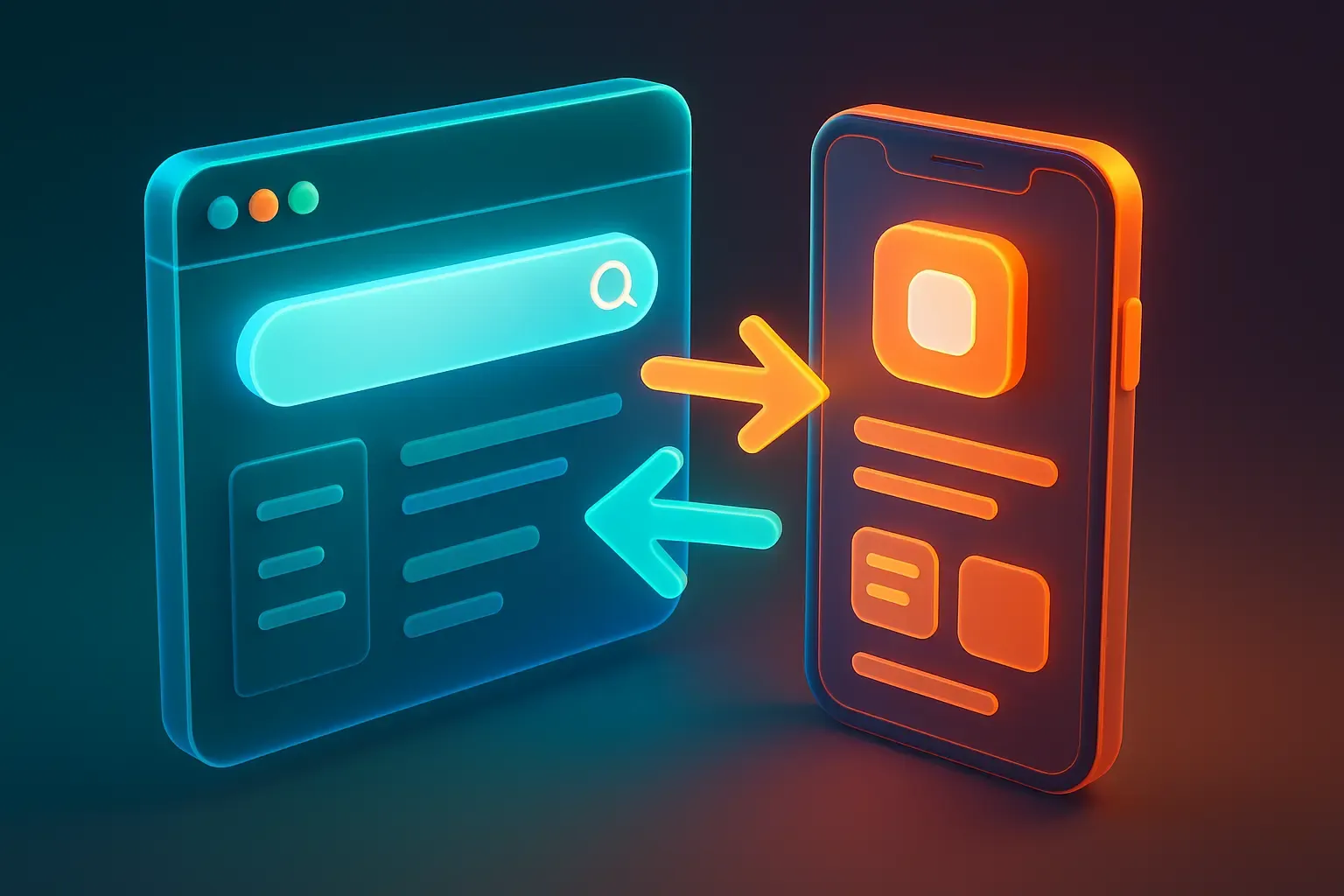

Website or App: What to Choose to Avoid Wasting Budget
For companies going online, the question almost always arises: stick to a website or launch a full-fledged app? The decision is not easy, and mistakes here can be costly.
The main difference: user behavior
A website is an entry point. It’s easy to open via link, click from advertising, or find in search. It acts like a business card: introduce the company, showcase services, and allow to leave an inquiry.
An app is a completely different level of engagement. You need to find it, install it, give permissions. Users do this only if they plan to return regularly.
Therefore, a website is effective for one-time visits, quick contact, initial engagement, while an app is for ongoing interaction. Schedules, bonuses, notifications, offline access — all of this is convenient in mobile format.
For example, if you have a beauty salon, a website is enough: the person booked and left. If you run a fitness service with progress tracking and recommendations, an app provides much more. It’s convenient to monitor workouts, accumulate points, receive notifications, and stay connected with the user.
When does an adaptive website suffice
In many cases, an app isn’t necessary. A responsive (adaptive) website works on all devices, loads quickly, and helps solve key business goals from first contact to order.
This format is suitable if you:
- Offer services with simple scenarios: legal advice, repairs, corporate training, etc.
- Sell up to 100 products without complex filters or recommendation systems.
- Operate in B2B, where structure, texts, and the ability to leave a request matter.
What the business gets:
- Fast launch without complex development.
- SEO optimization and search potential.
- Easy access — no need to download anything.
But a website has limits. It cannot send push notifications, remind users about updates, or integrate into daily routines. If regular interaction is required, then an app is a better option.
When to develop a mobile app
An app should be launched when the business depends on regular user interaction. If a client uses the service several times a week, the app becomes their primary access point.
Suitable for:
- Food delivery, taxis, marketplaces — where quick ordering and repeat visits are important.
- Fitness, training, habit trackers — for daily engagement.
- Loyalty and bonus programs — to remind and encourage return.
What the business gains:
- Instant access — icon on the screen.
- Push notifications — to send reminders about offers or abandoned carts.
- Integration with camera, geolocation, payments, and other phone features.
When relevance exists, an app becomes a serious competitive advantage. It helps retain attention and build a direct connection with the audience: not through search or social networks, but directly into the customer’s pocket.
3 common mistakes when choosing a format
Sometimes the decision to launch a site or an app is made without proper business justification — just out of inertia. “Competitors have an app, so we need one,” or “We made a website, and that’s enough.” As a result, investments don’t bring results because the format does not match the user scenario.
Typical mistakes:
- Launching an app without a strategy. No reasons for users to return, no push notifications, no benefits. Downloaded — deleted.
- Ignoring the mobile version of the site. The pages load with distortions, buttons are unclickable, forms don’t work. The audience leaves immediately.
- Trying to fit complex features like personal accounts, logic, and authorization into a site that’s not built for it. Users get confused and leave without completing the process.
The format should serve a goal: show, engage, sell, bring back. Otherwise, it is simply a waste of budget.
Ask the client before choosing
To avoid wasting budget, it’s better to rely not on trends, but on real user behavior. A beautiful app without a purpose will not contribute to growth. But a site that doesn’t retain users — is just a waste of money.
Before making a decision, answer a few questions:
- How often will the client return?
- Is it necessary to send push notifications or work offline?
- Is detailed analytics of user behavior important?
If you don’t have clear answers yet, it’s better to start with an adaptive website. It’s easier and cheaper to launch, faster to make changes, and test demand. From early data, you can understand how active users are, how many return, and what’s inconvenient for them.
If user behavior shows that they value regularity, personalization, and instant access — that’s a signal that you should consider an app.
The DigiNeat team works with both channels. We’ll help you choose the one that won’t eat up your budget but will bring you profit. We will develop an adaptive site or a mobile app tailored to your business scenario, focusing on increasing leads, repeat interactions, and customer convenience.