
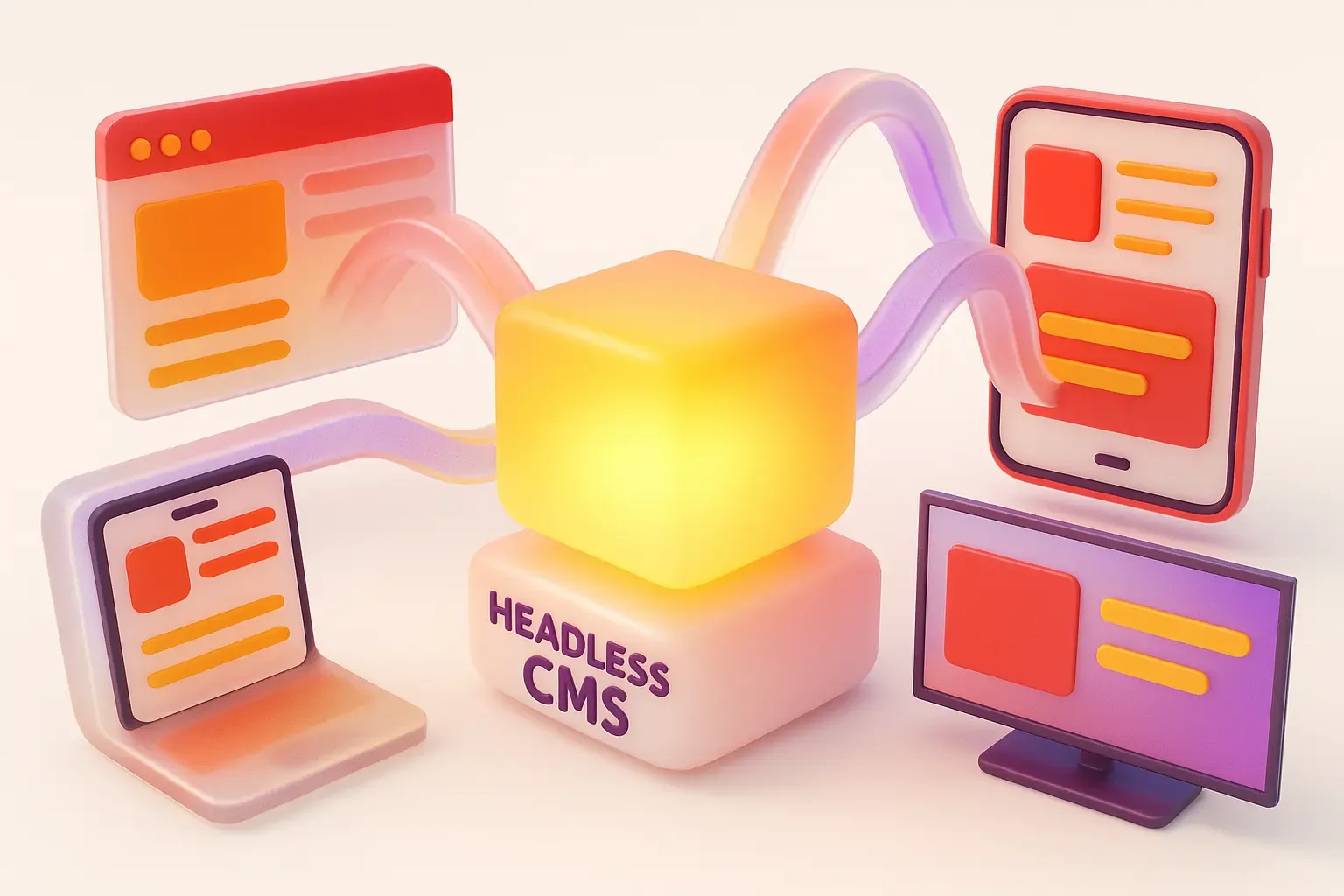

What is Headless CMS and How It Simplifies Content Management on a Website
In many projects, content is managed through a CMS — a system where texts, images, and page blocks are stored. Administrators add news, update storefronts, launch promotions. These systems are present on nearly every website.
Limitations of Classic CMS
Traditional CMSs have restrictions. Design, logic, and content are interconnected. Changing the structure or connecting a different channel (e.g., a mobile app) requires rewriting code. Any non-standard task demands developer involvement.
How Headless CMS Offers a Different Approach
Headless CMS separates content from presentation, offering more flexibility. Editors manage content directly, while developers work freely on interfaces. Let’s explore how it works, why it’s needed, and when it helps.
How a Classic Content Management System Works
- In a traditional CMS, everything is connected: what the user sees and what editors work with. A page comprises a template with embedded structure, logic, and content. Changing something in one place affects everything else.
- Initially, it’s convenient: one interface, one system, minimal approvals. But scalability exposes rigid boundaries.
- For example:
- You cannot simply connect a new channel — content must be separately reconfigured for mobile or landing pages.
- Adapting the site for a different country requires copying templates and creating duplicates.
- Any non-standard task needs developer involvement, even if it’s just changing text or buttons.
- The system itself becomes a bottleneck, designed for a simple, static website. For business, this means more manual edits, slower updates, complex support, and dependency on developers even for basic tasks.
What Changes with a Headless Approach
Headless CMS works differently. Content lives separately from the website. It doesn’t directly manage pages but stores data and delivers it via API requests.
This means the system doesn’t dictate how the site or app should look. Content is created once and can be used anywhere: on a webpage, in a mobile app, personal account, or Smart TV app.
Think of such a system as a warehouse. Content (goods on shelves), and storefronts (websites, apps) are just different displays of the same data. The display can change, but the warehouse stays the same.
Practical Benefits for Business
- Editors and marketers are no longer limited. They work directly with content, while developers build interfaces as needed.
- Frontend updates can be made without touching the CMS.
- The same content can be used across multiple channels without duplication.
- The tech stack is flexible: no bound to templates or legacy solutions — the interface can be built with modern technologies.
In the end, headless CMS allows building a system tailored to real tasks and workflows, especially when products change fast, content volume is large, and teams are divided across different directions.
Strapi — One of the Most Flexible Headless CMS on the Market
Among dozens of headless systems, Strapi stands out as a tool that suits both developers and businesses.
- Flexible data structure and API: The system doesn’t limit you in content types. The architecture is built around specific needs: website, platform, personal account, storefront. Once set up, it works across all channels.
- User-friendly admin panel: Content editors can update content without developer involvement. The admin panel supports roles, permissions, and change history, enabling teams—marketing, content, product—to work simultaneously.
- Compatibility with any interfaces: Strapi isn’t tied to a specific design or tech stack. You can connect it to websites, mobile apps, Smart TV interfaces, or B2B systems.
- Supports complex workflows: Handles diverse data sets — products, filters, nested blocks, dynamic content — simplifying management even in large, layered projects.
Another advantage is open-source code and an active global community, reducing dependency on specific vendors and ensuring long-term support and development.
DigiNeat uses Strapi as the primary headless CMS for flexible projects, from landing pages to comprehensive product platforms. Our approach allows tailoring architecture to client goals, enabling quick adaptation and scalable growth from the first release.